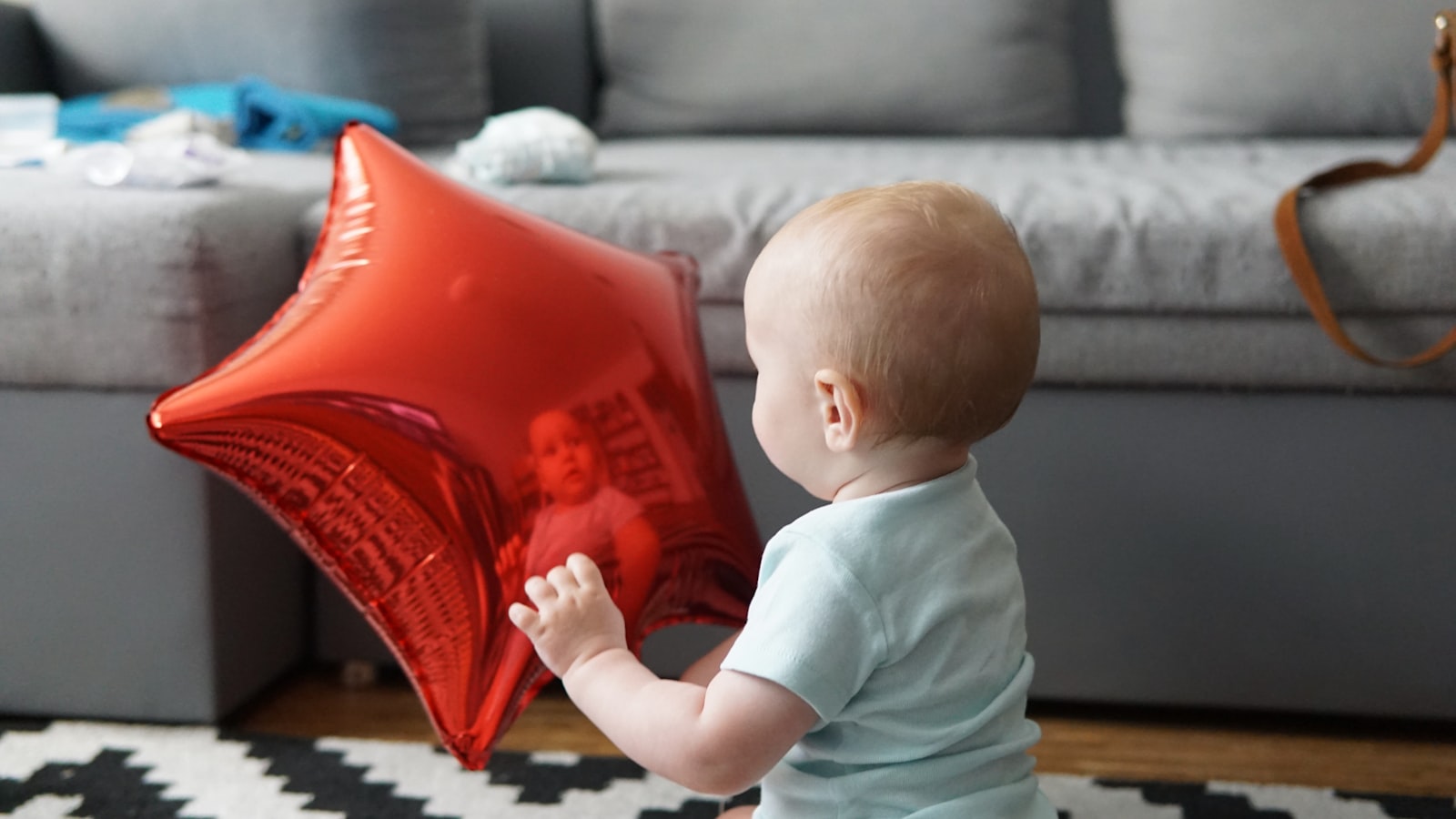
Baby-proofing isn't one task, it's a handful of specific, well-studied risks — and the fixes for most of them take an afternoon, not a renovation.
The most useful way to start is to get down on the floor at your baby's eye level and crawl through each room. Cords, outlets, sharp corners and small objects are all invisible from standing height and obvious from there.
Choking
The AAP notes choking is a leading cause of death for infants and young children, and roughly two-thirds of children who die from choking are under a year old 1. Cut food into pieces no larger than half an inch, and avoid whole grapes, hot dogs, nuts, seeds, hard candy, popcorn, and thick globs of peanut butter until your child is well past the toddler years 1. Always have your baby eat seated, never while crawling, walking, or playing — and keep balloons out of reach; they remain a top choking hazard up to age 8 1.
A quick test for non-food objects: anything that fits through a toilet-paper tube is small enough to choke on. That catches coins, batteries, magnets, bottle caps, marbles, small toy parts and detached button eyes.
Button batteries: the one to treat as an emergency
Button and coin lithium batteries deserve their own section, because the hazard isn't choking — it's chemical. A swallowed button battery lodged in the oesophagus can begin causing serious burn injury within two hours, and the early symptoms can look like an ordinary cough or fussiness 6.
Keep loose batteries locked away, and check that battery compartments on toys, remotes, thermometers, key fobs, musical cards and scales are screwed shut.
If you suspect a swallowed battery, go to an emergency department immediately — do not wait for symptoms and do not induce vomiting.
In the US, the National Battery Ingestion Hotline is available 24/7 at 1-800-498-8666 6.
The same urgency applies to high-powered magnets. Two or more swallowed magnets can attract through loops of bowel and cause perforation, which is a surgical emergency.
Falls, stairs, and windows
Install safety gates at both the top and bottom of stairs, mounted into the wall studs — avoid accordion-style gates, which can trap small limbs.
Open windows from the top only, or fit operable window guards. Screens are designed to keep insects out, not children in.
Never leave a baby unattended on a bed, sofa, or changing table, even briefly.
Move furniture away from windows, so there's nothing to climb.
Window blind cords
Looped blind and curtain cords are a strangulation hazard and cause deaths that are entirely preventable. Cordless window coverings are the recommended choice in any home with young children; where cords exist, they should be kept permanently out of reach and continuous loops secured with a tension device anchored to the wall. Cribs and furniture should never be placed near a window with cords.
Furniture and TV tip-overs
This one is more common than most parents realize: the AAP notes a child is treated in a US emergency department for a furniture or TV tip-over injury roughly once every hour, and 77% of tip-over deaths between 2000 and 2019 involved children under six 2. Anchor dressers, bookcases, and TV stands to wall studs using metal anchors (not the plastic ones that often ship with furniture), never place a TV on top of a dresser, and keep heavier drawer contents low 2.
Anchor everything that can be climbed, not just the tall pieces. An open dresser drawer becomes a staircase, and that's the usual mechanism.
Water safety
Drowning is the leading cause of death for children ages 1 to 4 3. A baby can drown in as little as two inches of water. Constant, within-arm's-reach "touch supervision" during any bath or pool time is non-negotiable — the AAP notes 69% of drownings in children under 4 happen outside of designated swim time 3. Empty bathtubs and kiddie pools immediately after use, and use four-sided isolation fencing around any home pool, which can prevent more than half of child drownings 3.
Indoors, the overlooked hazards are toilets, buckets, and any standing water. Toilet locks are worth it once a baby can pull to stand. Set your water heater to no higher than 120°F (49°C) to prevent scald burns, and always test bath water before your baby goes in.
Poisoning
Still reading? You might want the next one in your inbox.
New guides go out the moment they're published — no noise in between.
Store cleaning products, medications (including anything in a purse or bag), alcohol, e-cigarette liquid, and button or lithium batteries locked, out of sight, and out of reach — in their original containers with safety caps intact 4. The NHS flags laundry and dishwasher detergent capsules specifically, since their bright colors and packaging can look attractive to a curious toddler 4. In the US, the Poison Help line (1-800-222-1222) is available 24/7 if you suspect exposure.
"Child-resistant" is not "child-proof" — it means it takes most children longer, not that it stops them. Height and a lock are what actually work.
Room by room
Room | The specific things |
|---|---|
Kitchen | Stove knob covers, pan handles turned inward, cleaning products locked high, dishwasher detergent out of reach, oven lock |
Bathroom | Toilet locks, medicines locked, water heater ≤120°F, never leave water in the tub, non-slip mat |
Nursery | Furniture anchored, crib away from windows and cords, nothing in the crib, monitor cords out of reach |
Living room | TV and shelves anchored, corner guards, outlet covers, cords secured, small objects and batteries up high |
Stairs & halls | Hardware-mounted gates top and bottom, nothing to climb near railings |
Garage & outdoors | Chemicals locked, tools stored high, pool fenced on four sides, water containers emptied |
Crib and sleep-space safety
A firm mattress that meets current CPSC safety standards, nothing else in the sleep space (no pillows, bumpers, or soft toys), and room-sharing without bed-sharing for at least the first six months are the core of safe sleep 5 — see our full guide to newborn sleep for the complete picture.
The things that aren't baby-proofing but belong on the list
Working smoke and carbon monoxide alarms on every level, tested monthly.
A correctly installed car seat. Many fire stations and health departments offer free inspections, and a large share of seats are installed incorrectly.
Infant CPR and choking response. Knowing the difference between gagging and choking, and what to do, is worth an evening class.
Emergency numbers where a carer can find them, including Poison Help and the battery hotline.
Go to an emergency department immediately for a suspected swallowed button battery or two or more magnets — do not wait for symptoms 6. Call emergency services for choking that a child cannot cough through, any loss of consciousness, a fall with vomiting, unequal pupils, or a baby who won't wake properly, and for any submersion event even if the child seems fine afterwards. Call Poison Help (1-800-222-1222) immediately for any suspected poisoning — do not induce vomiting unless specifically told to. After any head injury in an infant, get advice rather than watching and waiting.
FAQ
When should I start baby-proofing?
Before your baby is mobile. Rolling and crawling tend to arrive sooner than expected, and retrofitting under pressure is how things get missed.
Are outlet plug covers enough?
They help, but the small ones can become choking hazards themselves. Sliding self-closing outlet covers are the sturdier option.
What's the most underestimated hazard?
Furniture tip-overs and button batteries. Both are common, both are severe, and both have very cheap fixes.
How hot is too hot for bath water?
Set the water heater to no more than 120°F (49°C) and always test the water yourself before your baby goes in.
Do I need a pool fence if we don't have a pool?
Not a fence — but do empty buckets, paddling pools and the bath immediately, and keep the bathroom door closed. Two inches of water is enough to drown in 3.
Is "child-resistant" packaging enough on its own?
No. It slows a child down rather than stopping them. Locked and out of reach is what works 4.
Crawl the house at your baby's eye level and fix the big five: choking, falls, drowning, poisoning, tip-overs. Anchor every piece of furniture that can be climbed, go cordless on blinds, set the water heater to 120°F, and treat button batteries and magnets as emergencies rather than choking risks. Put Poison Help and the battery hotline on the fridge where any carer can find them.
Sources
Every claim, sourced
6 sources cited in this guide
- 1Choking Prevention — American Academy of Pediatrics (HealthyChildren.org)Clinical guidance · Accessed September 2026
- 2Preventing Furniture and TV Tip-Overs — American Academy of Pediatrics (HealthyChildren.org)Clinical guidance · Accessed September 2026
- 3Water Safety and Young Children — American Academy of Pediatrics (HealthyChildren.org)Clinical guidance · Accessed September 2026
- 4
- 5Safe to Sleep — National Institute of Child Health and Human Development (NIH)Public health guidance · Accessed September 2026
- 6Button Battery Ingestion: Swallowed a Battery? — National Capital Poison CenterSafety guidance · Accessed September 2026