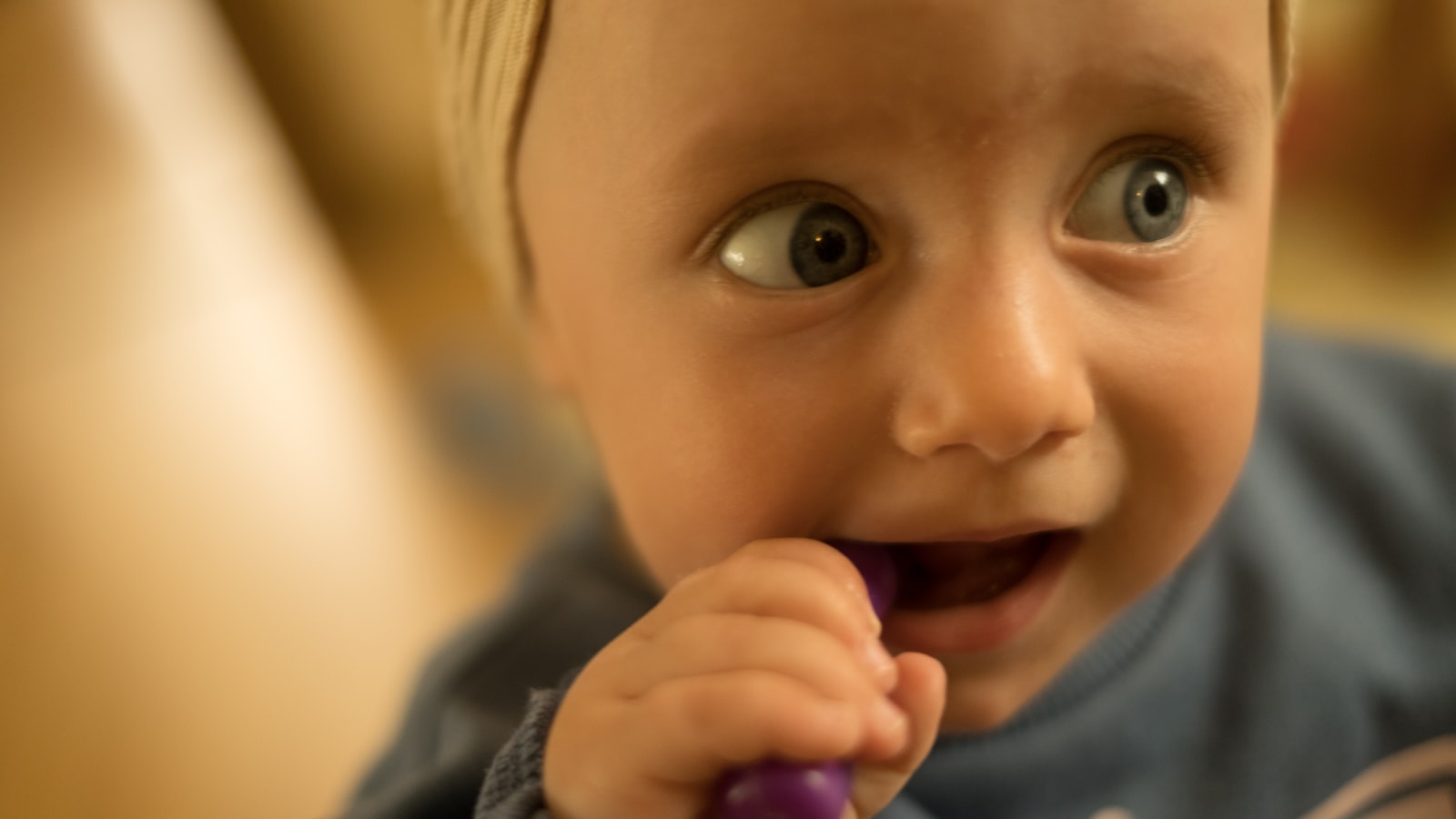
Real teething signs are local and mechanical: drooling, gum-rubbing, chewing, swollen gums and extra fussiness in the days around a tooth breaking through 1. Teething does not cause fever, diarrhoea or a runny nose. Counter-pressure and a firm chilled (not frozen) teething ring are what help. Skip amber necklaces, benzocaine gels and homeopathic teething tablets entirely 45.
First teeth usually arrive somewhere between 4 and 7 months, though the range that counts as normal is wide — some babies cut a tooth at 3 months, others not until closer to their first birthday. What's more useful than the exact timing is knowing which symptoms actually belong to teething and which ones get blamed on it unfairly.
What teething actually causes
The genuine signs are localized and mechanical: excess drooling, chewing on hands or objects, swollen or tender gums, and a baby who's fussier than usual — particularly around the tooth that's about to break through 1. These symptoms cluster in the days right before a tooth emerges and settle down once it's through 6.
That clustering is the most useful diagnostic feature you have. Teething symptoms come in bursts of a few days tied to a specific tooth, then stop. A symptom that has run steadily for a week is very unlikely to be teething, whatever else is happening in your baby's mouth.
What order teeth arrive in
The four front teeth — two upper and two lower — usually come first, starting as early as six months, and most children have a full set of 20 primary teeth by age three 3.
Teeth | Typical age |
|---|---|
Lower central incisors (bottom front two) | 6–10 months |
Upper central incisors (top front two) | 8–12 months |
Upper and lower lateral incisors (either side of the front) | 9–16 months |
First molars | 13–19 months |
Canines (pointed teeth) | 16–23 months |
Second molars (the back ones) | 23–33 months |
Wide ranges are normal and the order matters more than the dates. Teeth generally arrive in symmetrical pairs, and a baby who is months "behind" the table but following the sequence is usually just on their own schedule.
The fever myth, specifically
Teething does not cause a true fever, and this isn't a minor semantic point — the American Academy of Pediatrics is specific about it because the myth has real consequences. Teething may raise a baby's temperature very slightly, but not to 100.4°F (38°C) or higher, which is the actual clinical threshold for fever 1. Teething also does not cause diarrhea, diaper rash, or a runny nose, despite how often all three get attributed to it.
There's a simple reason the myth is so persistent: teething runs from roughly 6 to 24 months, which is exactly the window when maternal antibodies have waned and babies start catching everything. The teething and the illnesses genuinely do overlap constantly. That coincidence is not causation, and treating it as causation is how real infections get missed.
If your baby has an actual fever, treat it as an actual fever — not a teething symptom — and follow your pediatrician's guidance for their age. Blaming a real fever on teething is one of the more common ways an ear infection, UTI, or other real illness gets missed early. Any fever in a baby under 3 months needs same-day medical attention regardless of what you think is causing it.
What actually helps
Gentle counter-pressure — a clean finger or cool, wet washcloth rubbed on the gums for a minute or two 1
A firm (not liquid-filled) teething ring, chilled in the refrigerator, not the freezer — frozen rings can be too hard and bruise the gums 1
Something cold to chew, which is doing the same job as the ring: cold numbs, pressure counteracts the ache
Pediatrician-approved doses of acetaminophen or ibuprofen (for babies over 6 months) on genuinely rough days, following weight-based dosing
Extra comfort and closeness — teething discomfort is real, even without a fever
Counter-pressure is the underrated one. It costs nothing, needs no product, and it's the mechanism every teething toy is trying to reproduce.
What to skip, and why
This list is longer than the "what helps" list, which tells you something about the teething product market.
Amber teething necklaces. No proven benefit, and a real strangulation and choking risk if a baby chews through the string or beads break loose. Pediatric and safety organizations recommend against them.
Benzocaine gels and liquids. These carry a rare but serious risk of methemoglobinemia, a blood disorder, and the FDA does not recommend them for children under 2 4.
Prescription lidocaine for teething. The FDA specifically warns against using viscous lidocaine to treat teething pain, after reports of serious harm including overdose in infants 4.
Homeopathic teething tablets and gels. The FDA found inconsistent and sometimes dangerously high amounts of belladonna — a toxic substance — in tested teething tablets, and received reports of serious adverse events in children consistent with belladonna toxicity. Its position is blunt: there is no known safe dose of belladonna in children 5.
Frozen-solid anything. Refrigerator-cold, not freezer-hard.
"Natural," "homeopathic" and "amber" are marketing terms, not safety findings. The belladonna teething tablets were sold in ordinary pharmacies, labelled as gentle and natural, for years before the FDA's laboratory analysis found what was actually in them 5. Availability on a shelf is not evidence of safety — it is the single most reliable error in the whole baby-product category.
Still reading? You might want the next one in your inbox.
New guides go out the moment they're published — no noise in between.
Caring for the teeth once they arrive
Teething guides tend to stop at pain relief, but the tooth that just came through now needs looking after, and the current guidance starts earlier than most parents expect.
Start brushing with the first tooth. Use a soft infant toothbrush twice a day 3.
Use fluoride toothpaste from the first tooth — but only a smear, no larger than a grain of rice, until age 3. From 3 to 6, a pea-sized amount 23.
Book the first dental visit when the first tooth erupts, or by 12 months, whichever comes first 23.
Wipe gums before there are teeth. A clean damp cloth after feeds gets the habit started and keeps the mouth comfortable.
The fluoride advice changed some years ago — the older guidance was to wait until age two — so this is a genuine case where a grandparent's confident advice may simply be out of date rather than wrong at the time.
Drool rash, and other things teething really does cause
Heavy drooling is real, and the rash that comes with it is a genuine teething side effect — not on the diaper, but on the chin, neck and chest where saliva sits against skin. It's contact irritation, and it responds to the same approach as any irritant rash: pat dry often rather than wiping hard, and use a plain barrier ointment before naps and at night.
Teething can also disrupt sleep for a few nights around an emerging tooth. What it does not do is cause weeks of regression — sleep changes lasting longer than the tooth takes to arrive usually have another explanation.
Call your pediatrician for any fever of 100.4°F (38°C) or higher — especially in a baby under 3 months, where it needs same-day attention. Also call for diarrhoea, vomiting, a rash that spreads beyond the drool area, refusal to feed, or unusual lethargy: none of these are teething, and attributing them to it delays the right care. Ask about teeth specifically if no tooth has appeared by around 18 months, or if a tooth comes in discoloured or in an unusual position. Babies occasionally arrive with a tooth already present, which is worth a check to make sure it is stable enough not to be a choking risk.
FAQ
Can teething cause a fever?
No. It may raise temperature very slightly but not to 100.4°F (38°C) or above, which is the clinical threshold. A genuine fever needs to be treated as one 1.
Are amber teething necklaces safe?
No — there's no proven benefit and a real strangulation and choking risk. Pediatric and safety bodies recommend against them.
What about "natural" homeopathic teething tablets?
Avoid them. The FDA found inconsistent, sometimes toxic levels of belladonna in tested products and says there is no known safe dose in children 5.
Can I freeze a teething ring?
Chill it in the refrigerator, not the freezer. Frozen-hard rings can bruise tender gums 1.
My baby is 12 months with no teeth. Should I worry?
Usually not — the normal range is wide. It's reasonable to mention at a well visit, and worth asking about specifically if there's still nothing by around 18 months.
Real teething is local, mechanical and short-lived: drool, gums, chewing, a few rough days per tooth. Fever, diarrhoea and runny nose are not teething, and treating them as such is how real illness gets missed. Counter-pressure and refrigerator-cold rings help. Amber necklaces, benzocaine, lidocaine and homeopathic tablets should all be skipped — and once that first tooth is through, brush it twice a day with a rice-grain smear of fluoride toothpaste.
Sources
Every claim, sourced
6 sources cited in this guide
- 1Teething Pain: How to Help Your Baby — American Academy of Pediatrics (HealthyChildren.org)Clinical guidance · Accessed September 2026
- 2Good Oral Health Starts Early: AAP Policy Explained — American Academy of Pediatrics (HealthyChildren.org)Clinical guidance · Accessed September 2026
- 3Healthy Habits: Babies and Kids — American Dental Association (MouthHealthy)Clinical guidance · Accessed September 2026
- 4Safely Soothing Teething Pain in Infants and Children — U.S. Food and Drug AdministrationSafety communication · Accessed September 2026
- 5Some Homeopathic Products May Put You at Risk — U.S. Food and Drug AdministrationSafety communication · Accessed September 2026
- 6