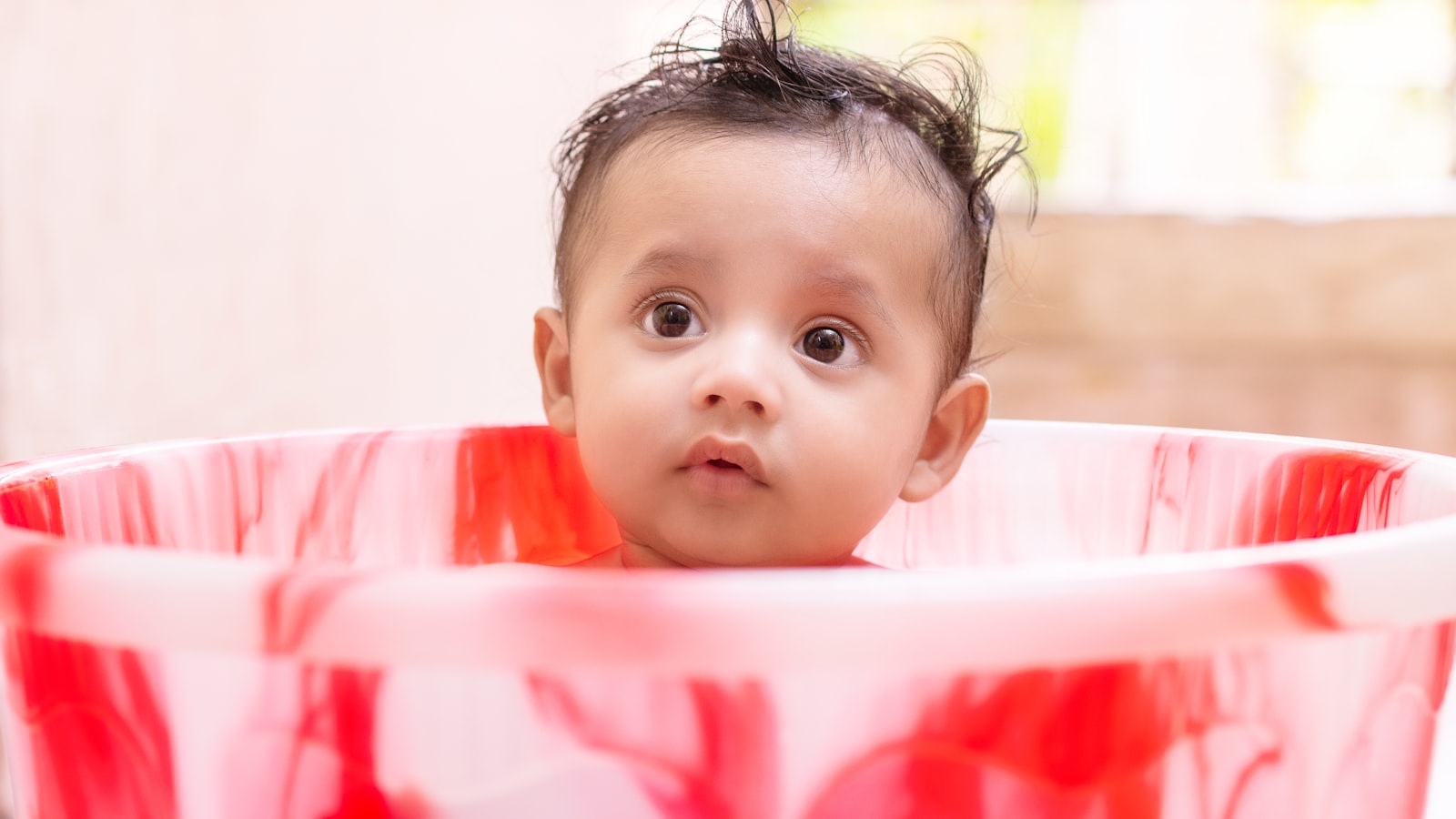
It's one of the most common newborn questions, and the instinctive answer — bathe them daily, like everyone else in the house — turns out to be wrong. Newborn skin doesn't need it, and over-bathing can actually cause problems.
How often to bathe a newborn
The American Academy of Pediatrics recommends three baths a week during a baby's first year, noting that bathing more often can dry out sensitive newborn skin 1. The NHS gives a similar range — two to three times a week is enough — while noting there's no harm in bathing more often if your baby genuinely enjoys it 3.
For the first four weeks specifically, the NHS recommends plain water only, with no soaps, shampoos, or lotions, since early exposure to those products can contribute to allergic reactions or eczema 3. The waxy vernix coating some babies are born with should be left to absorb into the skin naturally rather than scrubbed off 4.
What does need daily attention is "topping and tailing" — face, neck, hands and nappy area — which handles everything that actually gets dirty without stripping the skin everywhere else.
When to give the first bath
The World Health Organization's newborn care guidance recommends delaying a healthy, full-term baby's first bath for at least 24 hours after birth, specifically to reduce the risk of hypothermia 5.
Sponge baths vs. tub baths
Until the umbilical cord stump falls off — usually around one to two weeks — the AAP recommends sponge baths only, rather than submerging your baby in water 1. Once the cord area has healed, baths should still be brief and gentle.
For a sponge bath: lay your baby on a towel on a firm surface, keep them wrapped and only uncover the part you're washing so they don't get cold, and work top to bottom — face first with plain water and no soap, then body, nappy area last.
For a tub bath: get everything within reach before you start, keep one hand on your baby throughout, support the head and neck, and keep it short. Five to ten minutes is plenty.
Getting the water temperature right
Fill the basin with about two inches of water that feels warm — not hot — against the inside of your wrist or elbow. The AAP recommends setting your water heater so the hottest tap temperature never exceeds 120°F, specifically to prevent scald burns 1. The NHS gives the same wrist-or-elbow test, running the cold tap first and then adding hot water so there are no unmixed hot patches 3.
Room temperature matters too. Babies lose heat fast, so a warm room and a towel ready to go make the difference between a calm bath and a miserable one.
Never leave a baby alone in the bath, even for a few seconds — use "touch supervision," meaning a hand on your baby at all times. Both the AAP and NHS specifically advise against bath seats and rings: they can tip over, and a baby can drown in just a few centimeters of water, silently and within seconds 13. If the doorbell or phone goes, take your baby out and bring them with you. There is no version of this where leaving is acceptable.
Umbilical cord care while bathing
There's no need to use alcohol on the cord stump — just keep the area clean, and fold the diaper down below it so urine doesn't soak it 2. A few drops of blood around the time the stump separates is normal. The NHS advises only cleaning around the cord if it's actually dirty, using fresh cotton wool and warm water, then patting it dry 3.
Call your pediatrician if the umbilical cord actively bleeds, or if you notice foul-smelling yellowish discharge, red skin around the base of the cord, or your baby crying when the cord or surrounding skin is touched — these can indicate an infection that needs treatment 2.
Still reading? You might want the next one in your inbox.
New guides go out the moment they're published — no noise in between.
Cradle cap
Those greasy yellowish scales on the scalp are cradle cap — extremely common, not an infection, not caused by anything you did or didn't wash, and not itchy or uncomfortable for your baby 6.
It usually clears on its own within a few months. If you want to help it along: wash the scalp with a mild baby shampoo, loosen scales gently with a soft brush, and if it's thick, a little plain baby oil or petroleum jelly left on for a while before washing can soften it 6. Don't pick at it — that can break the skin and invite infection.
See your doctor if it spreads well beyond the scalp, becomes red and inflamed, weeps or bleeds, or doesn't improve with routine care 6.
Products, nails and everything else
Soap and lotion: plain water for the first month 3. After that, a mild fragrance-free cleanser used only where needed. Fragrance is the most common irritant in baby products.
Moisturiser: fragrance-free, and especially useful right after the bath for dry or eczema-prone skin.
Nails: trim or file them after a bath when they're softest, using baby clippers or an emery board. Mittens are an alternative for scratching in the early weeks.
Powder: skip it. Talc carries an inhalation risk for infants and cornstarch doesn't solve anything.
Bath additives, bubble bath and essential oils: not for newborn skin, and bubble bath in particular is associated with irritation.
Seek emergency care immediately for any submersion event, even if your baby seems completely fine afterwards. Call your pediatrician for redness, swelling, foul-smelling discharge or bleeding around the cord stump, a cord that hasn't separated by around three weeks, fever in a baby under 3 months, or any burn from bath water. Also call for a rash that is blistering, weeping or spreading, and for skin that stays dry and cracked despite consistent moisturising — that may be eczema needing treatment rather than a bathing problem.
FAQ
How often should I bathe my newborn?
When can I stop sponge baths?
Once the umbilical cord stump has fallen off and the area has healed, usually one to two weeks 1.
What soap should I use?
None for the first four weeks — plain water only. After that, a mild fragrance-free cleanser where needed 3.
How warm should the water be?
Are bath seats safe?
How do I get rid of cradle cap?
Usually you don't need to; it clears on its own. Mild shampoo, gentle brushing and a little oil to soften thick scale all help, but don't pick at it 6.
Three baths a week, plain water for the first month, sponge baths until the cord heals, and water no hotter than 120°F tested on your wrist. Keep a hand on your baby the entire time and never use a bath seat. Leave cradle cap and vernix alone — both sort themselves out.
Sources
Every claim, sourced
6 sources cited in this guide
- 1Bathing Your Baby — American Academy of Pediatrics (HealthyChildren.org)Clinical guidance · Accessed September 2026
- 2Umbilical Cord Care — American Academy of Pediatrics (HealthyChildren.org)Clinical guidance · Accessed September 2026
- 3
- 4
- 5WHO recommendations on maternal and newborn care for a positive postnatal experience — World Health Organization (via NIH/NCBI Bookshelf), 2022Clinical guideline · Accessed September 2026
- 6Cradle Cap — American Academy of Pediatrics (HealthyChildren.org)Clinical guidance · Accessed September 2026