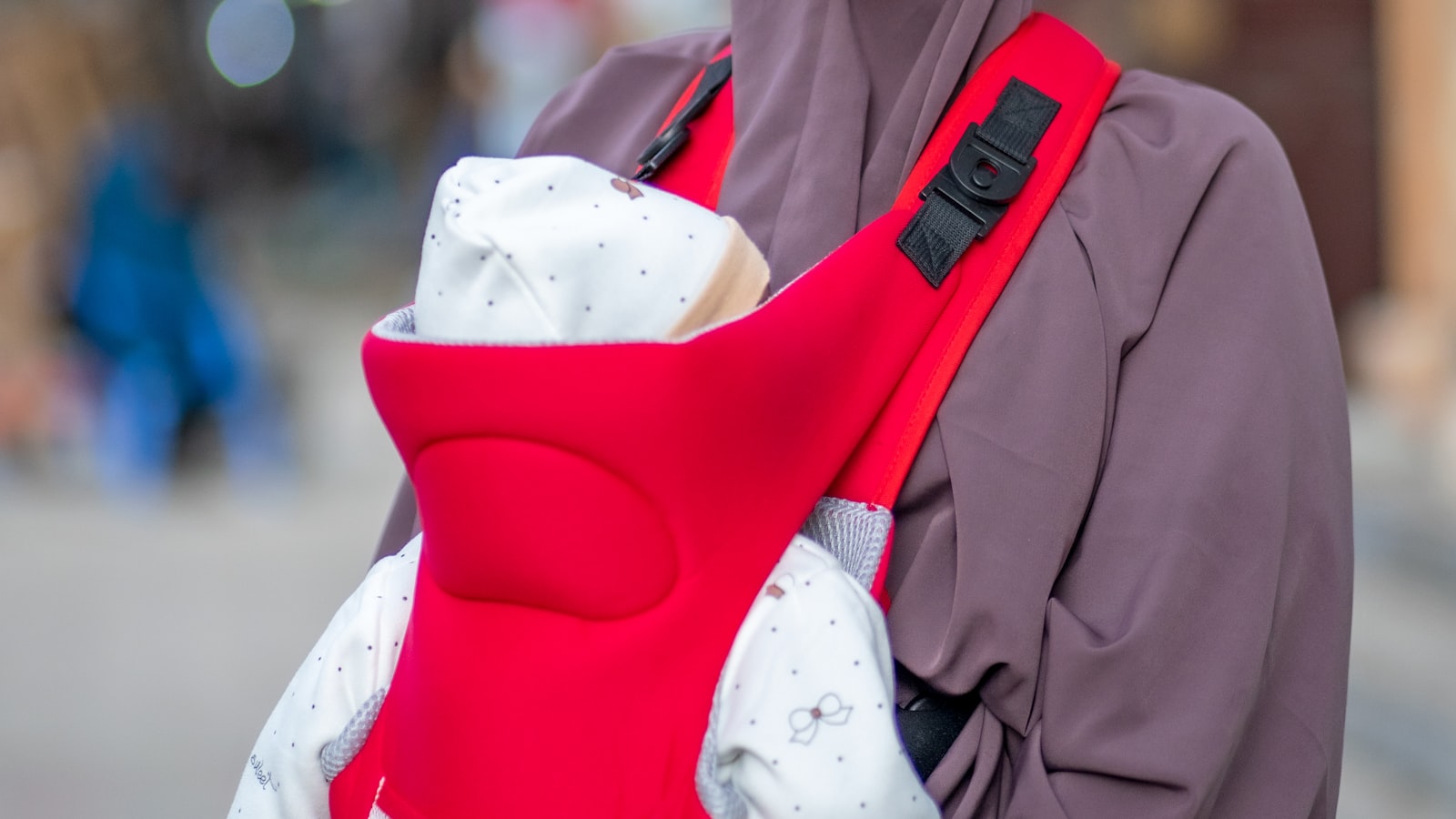
Almost all babywearing risk is about airway, not brand. Keep your baby tight, in view, close enough to kiss, chin off chest, and back supported — the T.I.C.K.S. rule 1. The highest-risk group is babies under 4 months, especially preterm, low-birthweight, or those with a cold: 12 of 14 sling deaths investigated by the CPSC were under four months old 2.
Wraps, slings, soft-structured carriers, buckle carriers — the styles vary a lot, but the safety principles behind all of them don't. The T.I.C.K.S. rule, developed by the UK Sling Manufacturers and Retailers Consortium, is the standard reference point, and it holds regardless of which specific carrier you're using 1.
The T.I.C.K.S. rule
Tight — the carrier should hold your baby snugly against you; loose fabric lets a baby slump into a position that can restrict breathing 1
In view at all times — you should be able to glance down and see your baby's face without adjusting the carrier 1
Close enough to kiss — your baby's head should be close enough to your chin that tipping your head down would let you kiss it 1
Keep chin off chest — a baby's chin pressed to their chest can narrow the airway; there should be at least a finger-width of space 1
Supported back — a baby's back should be gently curved, tummy and chest against you, not slumped or overly arched 1
The chin-off-chest point is the one most linked to real safety incidents — a slumped position can partially block a young infant's airway without obvious struggle. Check this position specifically every time you put a carrier on, not just when you first buy it.
Why the airway rules matter this much
It is worth being specific about the risk, because "keep the airway clear" sounds like generic advice until you know what's behind it.
The US Consumer Product Safety Commission identified at least 14 infant deaths in sling-style carriers since 1998, and twelve of those babies were younger than four months old 2. In a separate reporting window covering 2003 to 2013, the CPSC received reports of 16 sling-associated fatalities; eleven of those infants were one month old 3.
There are two distinct mechanisms, and both are quiet:
Fabric against the face. In the first months, babies can't control their heads because their neck muscles are weak. Sling fabric pressing against the nose and mouth can block breathing and suffocate a baby within a minute or two 2.
Curled position. A sling that holds a baby curled with the chin bent toward the chest restricts the airway and limits oxygen 2.
Neither looks like a struggle. A baby in trouble in a carrier usually goes quiet, which is exactly the opposite of the signal a parent is primed to notice. That is why "in view at all times" is a rule rather than a suggestion.
The CPSC specifically flags extra caution for babies under four months, babies born premature or at low birth weight, and babies with a cold or any breathing problem 2. Many of the infants who died in slings fell into one of those groups. If your baby is in any of them, talk to your pediatrician before using a sling-style carrier, and favour a structured carrier that holds the head and neck upright over a deep cradle-style pouch.
Hip-healthy positioning
For hip development, the position that matters is often called the 'M' or frog position — hips bent, knees spread out to the sides and slightly higher than the bottom, with the carrier supporting a baby from knee to knee, not just at the crotch 4. The opposite — legs hanging straight down and pressed together — is linked to a higher risk of hip dysplasia over time.
The IHDI is specific about what qualifies: a carrier earns its "hip-healthy" acknowledgement when it supports the thighs with the hips spread at roughly 60 to 120 degrees between the thighs 4. Research published in 2023 found that wide-base carriers hold an infant's hips in a position similar to the Pavlik harness used to *treat* hip dysplasia — with the hips seated more fully in the socket than in narrow-base carriers 4.
Most reputable carriers are designed with this in mind, but it's worth checking how a baby is actually seated once the carrier is on, not just trusting the product description. The test is simple: is the fabric reaching from one knee-pit to the other, or is the baby hanging by the crotch?
Inward or outward facing
Still reading? You might want the next one in your inbox.
New guides go out the moment they're published — no noise in between.
Inward-facing is the safer default, and for two separate reasons.
For the airway, inward-facing is what makes "in view" and "chin off chest" checkable at a glance. For the hips, the IHDI recommends inward-facing particularly during the first six months, the period of most rapid hip development 4 — an outward-facing position leaves the legs dangling rather than supported knee-to-knee.
Outward-facing becomes a reasonable option once a baby has solid head and neck control and the carrier is rated for it, and most babies enjoy it in short stretches. Keep those stretches short: facing out gives a baby no way to turn away from stimulation when they've had enough.
Carrier type | Best for | Watch for |
|---|---|---|
Stretchy wrap | Newborns, close contact | Loosening over the day; re-tighten rather than letting it sag |
Ring sling | Quick ups and downs, hip carry once older | Deep cradle positions that curl the chin to the chest |
Soft-structured / buckle | Longer wears, bigger babies, shared between adults | Minimum weight rating; whether it supports knee-to-knee |
Framed backpack | Toddlers, hiking | Not for infants without head and neck control |
A few more practical points
Newborns and young infants should generally face inward, toward the wearer, until they have solid head and neck control
Avoid babywearing while cooking, near hot liquids, or doing anything where a fall risk to you also becomes a fall risk to your baby
Check your specific carrier's minimum weight and age requirements — some aren't rated for very small newborns without an insert
A carrier is not a car seat. Never wear a baby in a moving vehicle
Check the fit again after feeding, after adding a coat, and any time the baby has fallen asleep — sleep is when a chin drifts onto a chest
Buy from a current, recalled-checked source. Sling carriers have been subject to a federal safety standard since the CPSC acted on these deaths 5, and second-hand carriers may predate it
If a carrier feels wrong or your baby seems uncomfortable, trust that over trying to force a position that isn't working
Seek emergency care immediately if your baby is unresponsive, limp, blue or grey around the lips, or breathing noisily or with difficulty after being in a carrier. Call your pediatrician before using a sling if your baby was born premature or at low birth weight, has any breathing condition, or currently has a cold 2. Also raise it if you notice your baby's hips click, one leg seems to move differently from the other, or thigh creases look uneven.
FAQ
What is the single most important babywearing rule?
Chin off chest, face visible. Airway position is what the documented fatalities involved, not carrier brand or style 2.
Can I wear a newborn?
Yes, with care. Babies under four months are the highest-risk group, so favour an upright, well-supported position over a deep cradle pouch, and check the airway constantly 2.
Is it safe if my baby falls asleep in the carrier?
It can be, but sleep is exactly when the head droops and the chin drops. Re-check the position every time they nod off.
When can my baby face outward?
Once they have solid head and neck control and the carrier is rated for it. Inward is recommended for hip development through the first six months 4.
How do I know if a carrier is hip-healthy?
Look for knee-to-knee support with the knees slightly higher than the bottom, not legs dangling from the crotch. The IHDI publishes acknowledged designs 4.
Can I use a second-hand carrier?
Check it against current recalls and confirm it meets the federal sling safety standard, which post-dates the CPSC's investigation into these deaths 5. Inspect fabric, seams and buckles for wear.
T.I.C.K.S. covers almost everything: tight, in view, close enough to kiss, chin off chest, supported back. The risk is airway, it is highest under four months, and it is silent — so look, don't listen. For hips, aim for knee-to-knee support with knees above the bottom, and keep young babies facing in.
Sources
Every claim, sourced
5 sources cited in this guide
- 1The T.I.C.K.S. Rule for Safe Babywearing — UK Sling Manufacturers and Retailers Consortium (Baby Sling Safety)Safety guidance · Accessed September 2026
- 2Infant Deaths Prompt CPSC Warning About Sling Carriers for Babies — U.S. Consumer Product Safety CommissionSafety communication · Accessed September 2026
- 3CPSC Educates New Parents on Safe Babywearing — U.S. Consumer Product Safety CommissionSafety communication · Accessed September 2026
- 4
- 5CPSC Approves New Federal Safety Standard for Infant Sling Carriers — U.S. Consumer Product Safety CommissionFederal safety standard · Accessed September 2026